Top 5 Tips To Prevent Diabetes

As you are already aware of increasing diabetes prevalence among indian population, it is very important to control and start preventive measures to control diabetes among us. To control diabetes it is important to control risk factors which predispose individual for getting diabetes.

Diabetes risk factors are either modifiable or non modifiable. certain risk factors like age, ethnicity, family hereditary etc are non modifiable or can not be changed but modifiable risk factors can be changed so that we can prevent or delay the disease.

based on modifiable risk factors following measures can prevent or delay the diabetes.

diabetes prevention
Image Credits : diabeteshelpsa.com

Tips to Prevent Diabetes :

  1. Staying Lean : Weight loss by means of diet and exercise helps to prevent or delay the disease. According to broca’s index Ideal weight (in Kgs) = Height (in cms) – 100         for example if a person’s height is 172 cms then his ideal weight is roughly 72 kgs.  If you are not able to loose weight even after 3 months of diet and exercise then certain weight loss medication like metformin, orlistat etc can be started but it is necessary to consult a diabetologist or weight loss specialist before starting such medication.
  2. Control Hypertension : restrictive salt intake and regular physical exercise helps to control your blood pressure. If your blood pressure is more than 140/90 mm of Hg even after regular exercise and diet restriction consult your physician to start anti-hypertensive medication.
  3. Control Stress : Majority of people working in corporate surrounding in metro cities like mumbai suffer from work stress and tension.  In physical or mental stress situations body releases stress hormones (cortisol, epinephrine etc) which increases blood pressure and have action opposite to insulin (raises sugars). peaceful sleep of atleast 8 hours at night & other stress relieving remedies like music, yoga, meditation etc helps to control stress.
  4. Avoid Excess Alcohol intake : Alcohol abuse with or without carbonated drinks (fizz) gives you empty calories leading to weight gain. also may lead to hypertension and dislipidemia. Limit your alcohol intake to not more than 2 standard drinks for men and single drink for women at a time.
  5. Quit Smoking : Smoking is not only a risk factor for diabetes but also a risk factor for cardiovascular morbidities. Smokers have 2 times more risk of getting diabetes than  non smokers.

As you get older chances of getting diabetes increases so it is advisable to check your blood sugar levels every year when you are above 40 years of age.

You can also read my previous article on Calculating the risk of diabetes for better understanding.

If you found this article helpful, please share it with your friends & family.

Awareness is Prevention.

Best Way To Take Insulin At Home

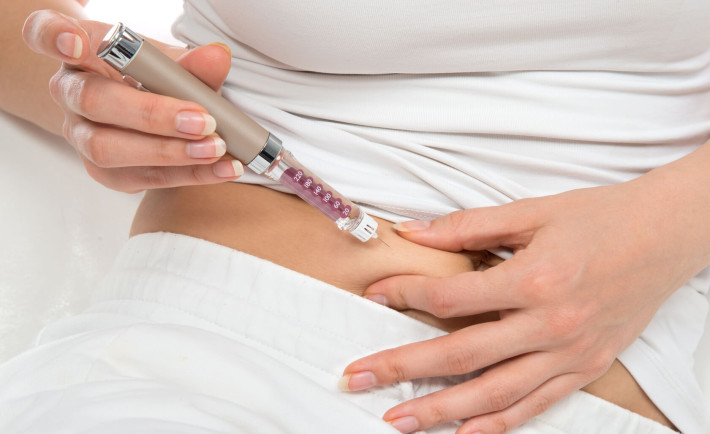
Many long standing Type 2 diabetes patients and Type 1 diabetes patients need to take daily insulin injections at home for maintaining their blood sugar level under control. Insulin is available in market in two injectable forms:  insulin vials or insulin pen (use & throw flex pen or re-fillable pen with cartridges).

insulin-
credits – e-diyabet.com

Where to inject insulin (Sites) ?

Insulin is injected subcutaneously, i.e just below the skin in fatty tissue. If insulin is injected deeper in muscles then it may get absorbed quickly and can lead to low sugars. Insulin should not be given in scars, moles, varicose veins, sites with broken blood vessels etc. as it may alter its absorption. Insulin injection site must be rotated each time to avoid lypodystrophy (Atleast take insulin injection an inch apart from previous site).

Sites where you can take insulin injection :

  1. Abdomen : this is the most preferable site for self administration since absorption of insulin is quicker and predictable. You can take insulin atleast two fingers width away from belly button.
  2. Thigh : This is second best site after abdomen for self administration of insulin injection. Top and outer aspect of thigh is preferred. Avoid injecting insulin on inner side of thigh.
  3. Arms : Normally when somebody else is administrating insulin to diabetes patient it can be given on outer back aspect of arm away from shoulder and elbow in fatty tissue.
  4. Buttocks : Upper outer padded part (wallet area) is preferred spot.

How to take or inject insulin ?

Insulin is stored in refrigerator  (In door shelf or tray but not in ice box part). Take insulin vial or pen out of refrigerator and allow it to come to room temperature (10-15 mins). Mix insulin via rolling insulin vial in your palms, do not shake insulin vial. Bolus and premix insulin should be taken before food (Regular insulin like actrapid and huminsulin R or premix like human mixtard 30/70 or huminsulin 30/70 should be taken 20-30 mins before food, Incase of rapid acting analogues like Humalog, Novarapid, Novomix 30, Humalog 25/75 etc can be taken just prior to meal)

Steps to follow for injecting insulin via Insulin vial

  1. Wash your hands thoroughly before taking insulin.
  2. Hold the syringe in upright position (Needle on top) and pull the plunger down until the tip of the plunger reaches the measurement equal to the dose you will inject.
  3. Remove cap of insulin vial & syringe, push the needle into the stopper and push the plunger down. The air replaces the amount of insulin you will withdraw.
  4. Keeping the needle in the vial, turn them upside down. Pull the plunger down until the black tip of the plunger reaches the correct dosage on the syringe.
  5. If there are bubbles in the syringe, tap it gently and the bubbles will rise to the top. Push the syringe to release the bubbles back into the vial. Pull the plunger down again until you reach the correct dose.
  6. Keep insulin vial down and hold a syringe like a pen
  7. Pinch the skin and Insert the needle at a 90-degree angle.If you are injecting into a site with less fat, injecting at a 45-degree angle is fine. Push the plunger all the way down and wait for 10 seconds before removing the needle.

Watch the video for more detail understanding of insulin vial & syringe administration technique :

video credits : CEMM

Steps to follow for injecting insulin via Insulin pen :

  1. Wash your hands thoroughly before taking insulin.
  2. Clean the site with cotton where insulin is injected.
  3. Remove the top cover part of insulin pen and attach needle to insulin pen by rotating it on upper side.
  4. Fix the number on dial on bottom side of pen equivalent to dose of insulin you need to inject. (normally 1 click = 1 unit)
  5. Pinch the skin and insert the needle at a 90-degree angle. Press the bottom part button of the pen till the dialer resets to Zero Again.
  6. Hold it for 10 secs till complete amount of insulin gets injected.
  7. Loose the skin and remove needle slowly.

Watch the video for more detail understanding of insulin pen administration technique :

video credits : diabetes.co.uk


If you get any problems while self administration of insulin, consult your diabetes specialist immediately. Improper administration of insulin may lead to complications like hypoglycemia, lypodystrophy etc.

If you like my article please share it with your friends and family.

Awareness is prevention!

Self Monitoring of Blood Glucose – SMBG Chart Free Download

Self monitoring of blood glucose (SMBG) is very crucial for those diabetics who are on insulin or on certain oral anti-diabetic drugs which can cause hypoglycemia. To achieve best glycemic control it is essential to know how your daily blood glucose levels are fluctuating in entire day.

It is easier for a diabetes specialist to adjust drugs or to adjust insulin dose if good SMBG record is maintained by the patient.

Normally we check fasting and 2 hr post prandial blood sugar levels in lab for routine follow up. There is bright chance of sugar excursions in the other post meal readings which gets unnoticed.  Even in case of HbA1c or Glycated hemoglobin test we get an average result of blood glucose of last 3 months.

In practice I have seen several patients who had fasting and post prandial blood glucose lab tests in normal range but HbA1c levels below 7 is not achieved because they might have high blood sugars in other post meals which has got unnoticed.

To achieve best blood glycemic control it is important to control blood sugar levels within normal limits during entire day and not just fasting or post breakfast levels.

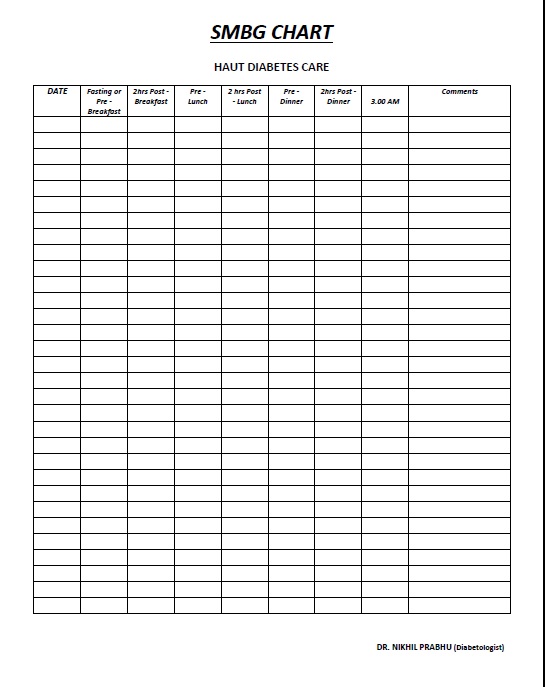
SMBG CHART :


Self Monitoring of Blood Glucose Chart (SMBG) Free Download

Interpretation of SMBG Chart :

In the above image of SMBG chart I have mentioned 7 point charting system where you can fill your blood glucometer readings which you take on several spots in an entire day. it’s also called as 7 point self monitored blood glucose.

Seven Points includes :

  1. Fasting or before breakfast reading
  2. 2 hrs after breakfast
  3. before lunch
  4. 2 hrs after lunch
  5. before dinner
  6. 2 hrs after dinner or bedtime
  7. At mid night 3.00 AM

This seven point SMBG charting approximately covers entire day glucose fluctuations to some extent (ofcourse  not as accurate as CGMS).

I have also mentioned a comment column in the above SMBG chart where you can note down change in food or change in insulin dose or any other changes that you have made which probably caused unusual readings like for example if Hypoglycemia occurs at before lunch reading and you have skipped breakfast or had very little snack at breakfast you can mentioned that.

You do not need to check daily all the 7 points, you can check any one or 2 points randomly depending upon your sugar control.

More uncontrolled blood sugars requires more frequent SMBG glucometer monitoring.

Monitoring of blood glucose at home in case of diabetic pregnancy or gestational diabetes is also important where frequent monitoring and SMBG charting of glucometer readings helps a lot to patient.

Download SMBG chart in PDF format below and take print of it.

DOWNLOAD SELF MONITORING OF BLOOD GLUCOSE CHART FOR HOME HERE :

SMBG CHART

I hope this article will help you to control your blood sugar levels more efficiently.

If you find that some of the post meal or pre meal readings are high or low, please consult your diabetologist with SMBG chart to adjust your medication or insulin dosage.

If you like my article please share it with your friends and family.

Awareness is prevention!

HbA1c Normal Range for a Diabetic – Most Reliable Test

HbA1c or Glycated Hemoglobin is most reliable test for confirming diabetes. HbA1c measurement has a central role in management of diabetes. HbA1c levels can be directly related to the risk of development of diabetic complications.

What is HbA1c (Glycosylated Hemoglobin) ?

Hemoglobin in blood reacts spontaneously with glucose to form glycated  derivatives in a non enzymatic manner. The process occurs slowly, with the extent of glycation determined by the concentration of glucose in the blood. Human hemoglobin A undergoes such glycation to form HbA1c from a reaction between the Beta chain of  hemoglobin A0 and glucose. Other compounds result from similar reactions on the alpha and beta chains of hemoglobin and these can be measured as the total glycated hemoglobin.

Which conditions affect HbA1c levels ?

Glycated hemoglobin can be affected by the presence of hemoglobin variants and uremia. Vitamin C, Hemolytic and Iron deficiency anaemia can also give abnormal results. Other conditions in which there is a rapid turnover of red blood cells ( e.g. polycythemia, anaemia or blood transfusion) can also give inaccurate results.

Why HbA1c (Glycated Hemoglobin) is most reliable test for Diabetes ?

HbA1c (Glycated Hb) serves as a retrospective indicator of the average glucose concentration over the previous 6-8 weeks. Approximately 50% of the variance in HbA1c is determined by the average blood glucose concentration over the previous month. 25% by the concentration over 30-60 days, and the remaining 25% by the concentration from 60 -120 days ( Red blood cells have lifespan of around 120 days).

  • HbA1c offers a potentially easier, non -fasting and therefore more acceptable test.
  • There is less intra individual variation with HbA1c than glucose testing. ( Fasting blood sugar test can vary in intra individual depending on hours of fasting, quantity and quality of food consumed )

HbA1c

How HbA1c is interpreted ?

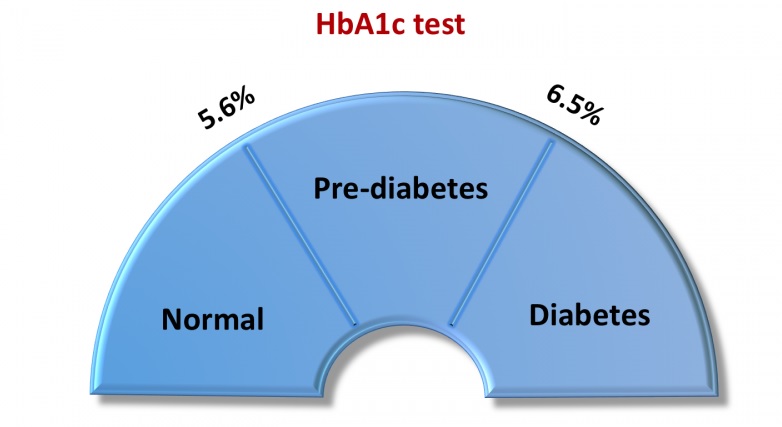
Results of HbA1c can be interpreted for diagnosis of diabetes as :-

5.6 % and below = Normal

5.7 – 6.4% = Pre-diabetes

6.5% and Above = Diabetes 

At the time of diagnosis if you have HbA1c of less than 5.7 % that means you do not have diabetes (excluding conditions affecting HbA1c readings mentioned above). If your reading is between 5.7% -6.4 % then you are in Pre-diabetes stage i.e. you have risk of developing diabetes. At this stage diabetes can be reversed to normal with diet, exercise (weight loss) and certain medication which enhances insulin sensitivity. 6.5% And above HbA1c indicates established diabetes. If your blood sugars are in Pre-diabetes range or established diabetes range then consult diabetes specialist immediately.

In already established diabetic person HbA1c monitoring helps diabetologist to check the control of blood sugar in preceding 3 months and can titre medication according to it.

According to ADA guidelines HbA1c of < 7 % is the goal for diabetes management. In younger patients tight control (HbA1c of 6.5%) is even better in minimizing the complications of diabetes.

It has been proven by DCCT & UKPDS trials ( Type 1 & 2 diabetes patient study) that reduction in HbA1c even by 1 % reduces majority of microvascular complications ( retinopathy, neuropathy, nephropathy) & macrovascular complications ( peripheral vascular disease, amputations, heart failures).

HbA1c is also used for monitoring sugar control progress during pregnancy.

That was all about HbA1c (Glycated Hemoglobin) and its use.

If you like my article please share it with your friends and family.

Awareness is prevention !

Ref : page no.399,400,401 Textbook of Diabetes 4th edition wiley-blackwell